Showing posts with label critters. Show all posts

Wednesday, February 20, 2013

A Wandering Adventure

~ WARNING ~
Dear Carr cousins and sweet friend Melissa,
There is a gratuitous snake photo in this post.
My apologies.


Last Saturday, the boys and I rambled along in an unplanned adventure.

It was the kind of thing my mother adored. I love it too.

My boys, however, live for structure. Even if the destination is a surprise, they still like to know we'll be there at ten, have lunch around noon and head for home at two. Spontaneous is not their middle name.

Saturday, after a lazy morning and big breakfast, I herded my guys and their visiting cousin to the car. It was cold and drizzling when we pulled out the driveway. We headed south to Greenstreet Gardens planning to attend the "Hoot is in Your Backyard" event I mentioned Friday.

We were a little late.

By the time we got there and parked, most of the show was over and the crowd was thinning. We walked around and met this young owl, but he was ready to go home. We didn't even get his name.


The proceeds for the "Hoot" event went to the Friends of Jug Bay, a non-profit supporting the Jug Bay Sanctuary. The Friends had a couple of tables with displays about the sanctuary.

That gave me an idea.

I herded the boys back to the car, stopping to take this photo on our way.


We headed southwest for another twenty minutes to Patuxent River Park in Upper Marlboro, Maryland and stopped at the Jug Bay Visitor Center. The boys studied a stuffed bald eagle on display while I talked to a friendly park worker about the trails, rural life museums and other attractions. The museums are only open in the warmer months, but we left happy, laden with handfuls of pamphlets and maps for future adventures.

And I had another idea.

We traveled for another ten minutes down winding, rural roads to a park we've visited before. Our old friend Merkle.

No impossible quests today. We were met by a young and enthusiastic ranger. She walked the boys around the nature center exhibits brought out a red corn snake to meet us.

We all pet her. She was silky smooth.


We met a few more snakes and three turtles. Our favorite was the alligator snapping turtle. No one knows how old this grumpy fellow is. He's just old. And grumpy. And armored like a dinosaur.

Gabe pressed his nose against the aquarium for a better look and CHOMP! against the glass. Gabe jumped back and there were peals of laughter from all three boys. The old fellow poked his head out the water.

"What's so funny?" he seemed to say.


Spontaneity! That's what!

Monday, January 28, 2013

Tracks

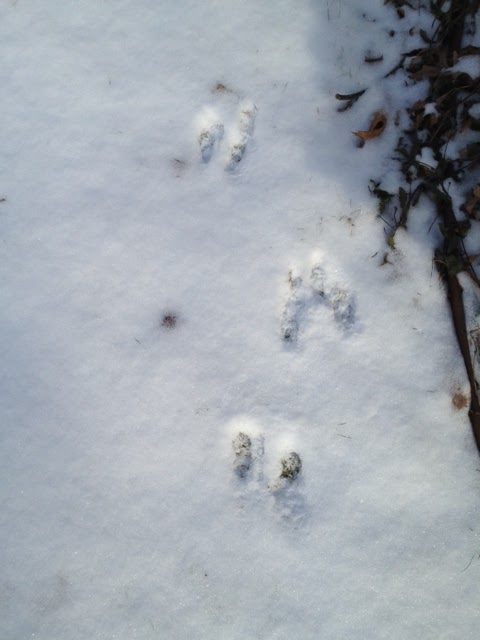
There are many little creatures that live in our yard and in the woods around our house.

They hide themselves well and one must be quiet and still (and have shut the cat in the house) to see them. But when it snows, they leave evidence of their existence behind.

Sparrows and Juncos

Squirrels
 
And although I didn't see their tracks this weekend, the boys and I have also seen evidence of deer, fox and the occasional raccoon. 

On Saturday, I also saw these.

 Prince the Cat
 
And these giant things, belonging to some strange beast. . .


Or maybe to just some silly mom wandering her own yard.

Wednesday, August 29, 2012

Wildlife Wednesday: the Black Bear Revisted

(or rather "The Black Bear Almost Visited")


I wrote a somewhat pedantic post about black bears a while back. If you want to know a few bits of trivia about black bears in Maryland, courtesy of yours truly, that's the post for you. This is more of a story.

I'll begin it right.

Once upon a time, a mom and her two boys went to Deep Creek Lake State Park for a Park Quest. It was a beautiful day and they enjoyed the drive over the mountains from their campsite near Cumberland to the westernmost reaches of their state. They arrived at the Deep Creek Discovery Center and enjoyed  exhibits about local mining history and native wildlife.


A ranger at the center gave them their quest packet and they began following a series of clues to find three letterboxes, the first of which was in the Discovery Center. The other two were out on a trail.

They followed the advice of a fellow quester and drove to the trailhead where they found this map.


The mom compared the photocopied map in their quest instructions with this sign and found they didn't quite match. The portion of the trail they needed was smudged out on the sign and alas! The family walked right past a small sign with a symbol of a mine.

They walked and walked and walked. The trail was very steep. After a while, the mom realized they were on top of the mountain and walking along a ridge. It was very beautiful and very quiet.

"Boys, I think we're on the wrong trail," the mom said. It was at that moment she looked down and saw four deep lines in a soft patch of ground followed by a large roundish indentation.

Unfortunately for my photo, Gabe stepped on the print.
You can still clearly see three of the claw marks.
 "Hmm, let's turn around now," she said and the three made record time back down the mountain.

- The End -


Wednesday, August 22, 2012

Wildlife Wednesday: the Timber Rattlesnake

Our first night in camp, I struggled to light a fire with wet wood.  Matt squatted beside me to explain what I was doing wrong. Gabe played at the picnic table. There was a small commotion on the opposite side of the camp loop, but the campground was crowded and we were engrossed in our various activities. We didn't think much of it.

The next night, we attended a campfire program on amphibians and reptiles. During the Q&A, the speaker was asked about local rattlesnakes and he flipped back through his slides to illustrate his answer.

"My picture isn't very good," he lamented.

"We have a great one on our phone!" said a woman in the audience.

"Oh, I heard about you! You had two in your campsite didn't you?"

At this point, the conversation had the attention of everyone in the audience.

The family was staying in one of the camper cabins in the campground.  They were collecting firewood for their fire when their young son heard the sound of a rattle.  He backed off and called his mom who promptly called the rangers. Not one, but two rattlesnakes were found at the base of their cabin doing "the dance of seduction." The rangers called someone specially trained to handle venomous snakes. They captured the snakes and took them farther up the mountain away from people.

"I heard they were abundant this year," the speaker said.

I like to think of myself as a nature girl, but I was a little freaked out by this. Coming across a snake in our yard or while cleaning out a stream in Baltimore City is one thing. Poisonous snakes are extremely rare, if non-existent in the Maryland lowlands. Hearing where you're about to spend a week outdoors is potentially infested with rattlesnakes is a whole other ballgame.

I spent half the night thinking every rustle in the leaves was a snake passing through our site. The next morning, I ran into a ranger at the camp store and asked a few pertinent questions. Infested was not at all accurate, but it was mating season and they had seen more snakes than usual.

"We've moved 13-15 out of the populated parts of the park this summer," she said.

So, still a little freaky but manageable. After all, this was their home, not mine.

The boys and I talked about snakes in general and how important it is to watch where you put your feet. We talked about listening with our ears as well as looking with our eyes when we hike.

"So we can hear rattles?" Gabe asked. That boy is no fool.

"Yep," I said. I slept soundly the rest of our trip, but in all honesty, I was a little tense about the boys exploring beyond the perimeters of our campsite.

The boys were completely unphased. In fact, every night, we had competing prayers.

"PLEASE, let us see a rattlesnake and a bear," Gabe prayed.

I would quickly follow, "PLEASE, let us NOT see a rattlesnake and a bear."


Not my photo (I hope to never get this close).
Courtesy of Wikipedia.
My prayers were mostly answered.

- - - - - - - - - - - - - - - - - - - - - - - - - - -
Sources and Further Reading

Crotalus horridus - Wikipedia
http://en.wikipedia.org/wiki/Crotalus_horridus

Rattlesnakes (video) - Home & Garden Information Center
A University of Maryland Extension
http://www.youtube.com/watch?v=H1SqfXRAtww&list=PL852ACC2FB9AACF50&index=9&feature=plpp_video

Timber Rattlesnake - Maryland DNR Field Guide to Maryland's Snakes
http://dnr.maryland.gov/wildlife/Plants_Wildlife/herps/Squamata/TimberRattlesnake.asp

Thursday, June 7, 2012

"Ticked Off"

After last year's experience with ticks, I don't mess around with the things. And since my post regarding Matt's misadventure remains the most popular entry on this blog, I thought I'd link to the following tip sheet courtesy of Park Quest and a host of official agencies.

In case you're in a hurry, I'll sum up tick removal:
  1. If you have a tick attached to you, DON'T use Vaseline or soap or WD-40 or anything else your dad swears by. Trying to "smother" the tick will only cause it to regurgitate any bacteria it's carrying into you (gross).
  2. Use a pair of tweezers to grasp the little monster as close to the skin as possible.
  3. Pull straight off.
The tip sheet also lists information on Lyme disease as well as tips for keeping ticks off in the first place.

- - - - - - - - - - - - -
Resources

All the tick references on my previous post as well as:

IWIF Safety Tip Sheet: Maryland Get Ticked Off About Lyme Disease
http://www.dnr.maryland.gov/parkquest/pdfs/lymediseasefactsheet.pdf

Wednesday, June 6, 2012

Wildlife Wednesday: Weird Moth-like Thing

That's its official name.


Originally, I thought it was a hummingbird moth and that still might be the case. At least with this fellow on the top.  He/she looks a lot like this moth on the Bug Guide, which lists the common name as such.


I posted this second picture to Project Noah and someone commented it was not a hummingbird moth. The distinct stripes mean it's a normal sphinx moth, specifically Amphion Floridensis.

May I remind you I got a "D" in ninth grade biology?  Therefore, my final label for this critter is: "weird moth-like thing."

- - - - - - - - - - - - - - - -
Resources

What would I do without the BugGuide?  The guide can be found at http://bugguide.net and for the record, states that both of the above are members of the sphinx moth family.

Project Noah - we've just started playing with this. I have the app on my phone. The website describes it as "a tool to explore and document wildlife and a platform to harness the power of citizen scientists everywhere." I'll write more about it when we've had more experience with it.

Wednesday, December 21, 2011

Wildlife Wednesday: Snails

Today, it's cold and overcast. But just a few weeks ago, it was pleasant and sunny. We spent the entire day outside and happened to spot this guy.


He was tiny.  His shell no bigger than a penny.  If I hadn't sat down on the porch for a breather and he hadn't been trekking his way across this bit of wood, I wouldn't have seen him.

Matt and I watched him for a while, but lost him once he hit the mulch of the flower beds.

I surfed the web to see if I could identify him beyond "snail."  But quickly realized there are lots of snails that to the uneducated eye look exactly like this one.

I did, however, learn some cool snail facts:
  • there are more fresh and salt water snails than land snails.
  • snail shells are part of their anatomy.  They aren't like hermit crabs.
  • land snails are usually herbivores and eat things like leaves, fungi and algae.
A snail fact I've known for a while:
  • one can easily and accidentally commit mass snail murder if one keeps them in an aquarium.
- - - - - - - - - - - - - - - - - - - - - - - - 
Sources and Further Reading

"Snails and Slugs," BBC Nature
http://www.bbc.co.uk/nature/life/Gastropoda


"Snails and Slugs," UC IPM Online Statewide Integrated Pest Management Program
http://www.ipm.ucdavis.edu/PMG/PESTNOTES/pn7427.html

Snail's Tales,
http://snailstales.blogspot.com/

Tuesday, August 16, 2011

Itchy

Just as the itchiness and sense of creepy crawlies from our tick run in faded, I was helping with yard work at my aunt's and stirred up an ant nest.  I didn't notice until I had the little stinkers crawling all over me.  So, instead of writing the post I was going to write tonight, I will instead be taking a shower and continuing my friendship with a bottle of calamine lotion.

Wednesday, August 10, 2011

Wildlife Wednesday: Seed Ticks

I already hated ticks.  To me, they're spiders that won't brush off (and we all know how I feel about spiders). After this weekend, I have a renewed disdain toward the parasitic arachnid.

The boys and I woke Friday morning and emerged sleepy-eyed from our tent.  I built a fire, made breakfast and packed our daypacks. By nine we were headed for the Pocomoke Park Quest in Milburn Landing.

We easily found the park and the starting point for our quest.  We opened the lid of the wooden chest containing our quest equipment and instructions.  The lid was heavy and it opened with a crash. I jumped back with a squeak.

Not a seed tick. Very big wolf spider.
We quickly grabbed our gear, checked it for other eight-legged friends, and hit the trail.  All three of us were coated in bug repellent, but it was the natural stuff.  Deet makes me sick and I've always figured, unless we're hiking in malaria prone areas, we'll forego the chemicals.  I may revise this thought process.

We completed our quest (a sort of combination letterbox/activity deal) with ease.  But somewhere between the oversized Wolf Spider, the cyprus swamp, and the Pocomoke River, Matt walked through what others on the Internet call a tick bomb.

We didn't know until he used the restroom post-quest.  He opened the stall door to show me a spattering of bug bites in the area of his shorts.  At first, I thought he got an ant in his shorts, but by the time we got back to our tent, he had over a hundred bites on his torso.

"What are these little black things?" he asked.  I looked closer and realized they were teeny tiny, smaller than a pinhead, ticks!  We stripped him naked and began picking the things off.  I did my best to squish each one with my fingernails and deposited them in a ziplock bag.

The blurred dot by my thumb is the tick.
BugGuide has a clearer image.

I lost count of how many we pulled off Matt, but the real problem came when we realized twenty-four of the evil things had attached themselves where no boy should have ticks attached. My boy was not letting me anywhere near that area with my tweezers.  I didn't have vaseline with us, but I tried a thick first aid cream to see if they would release. No luck.  We tried a long soak in the chlorinated water of the pool. No luck.  In the end, we went to the emergency room.

The E.R. staff was very sweet.  The nurses tried several applications of vaseline and a special soap (which it turns out, is the wrong thing to do), but still no luck. The doctor saw us for less than a minute and was convinced the boy had chiggers. She sent us home just before midnight with a prescription for an antibiotic and instructions to get some lice shampoo, kill the little buggers and use sticky tape to remove the carcasses.

I did not buy the chigger diagnoses, but the lice shampoo worked to some degree.  A day in the ocean got rid of even more. A conversation with a sympathetic ranger at Jane's Island pointed me toward the seed tick diagnosis.  As soon as we got home, I hit the Internet and confirmed her suspicion.

According to my research, chiggers leave flat, welt-like bites.  Ticks leave raised, hard bites.  Chiggers are nearly microscopic and difficult to see with the naked eye.  Seed ticks are extremely small, but I was able to make out legs even without my bifocals.

Seed ticks are not a specific kind of tick, but are "baby" ticks. They hatch in the thousands.  Walking through a newly hatched nest is like being sprayed with tick shrapnel. Hence the term "tick bomb." Matt was lucky in that he picked up a hundred or so, but not a thousand.

I'm scratching just thinking about them.

In the end, I waited until he fell asleep and got the last two with my tweezers.  Hopefully, the kid hasn't been traumatized for life by the great ... or rather tiny outdoors.


- - - - - - - - - - - - - -

Sources and Further Reading

"First Aid for Tick Bites," Oklahoma Poison Control Center
http://oklahomapoison.org/general/tick.asp

"Seed Ticks: The Devil's Spawn," Mayaland
http://mayalassiter.com/2009/08/seed-ticks-the-scourge-of-the-earth/

"Seed Ticks," Flea and Tick Control
http://www.flea-and-tick-control.info/seed-ticks.htm

Wednesday, July 27, 2011

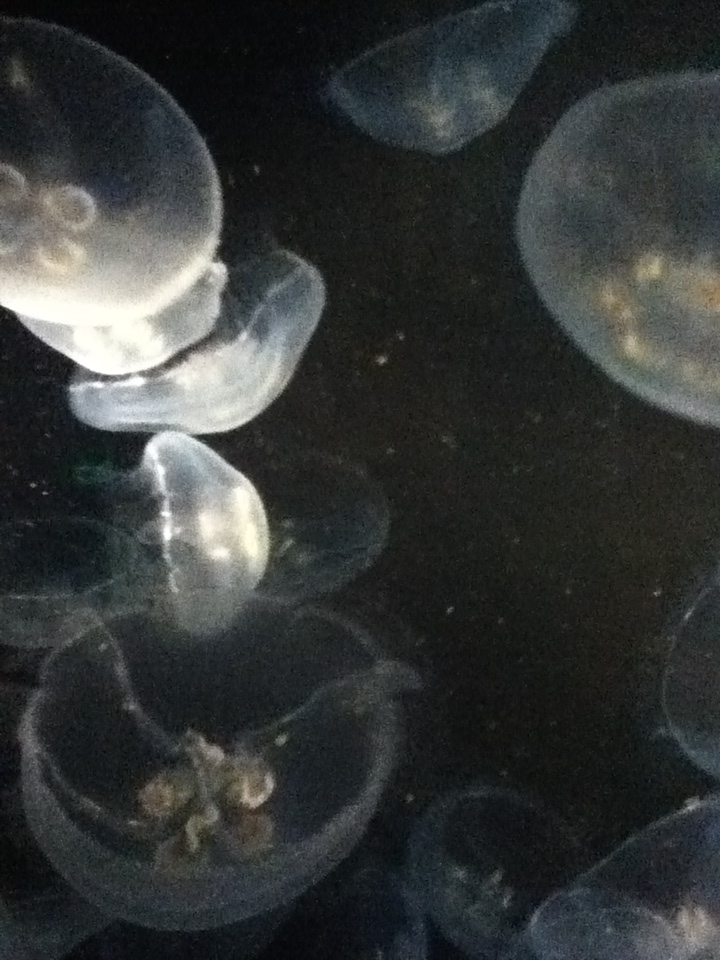
Wildlife Wednesday: Jellyfish

We spent last Sunday afternoon at the Calvert Marine Museum in Solomon's, Maryland. I plan to post more about this wonderful little museum later, but for now, I'll just share our critter for Wildlife Wednesday: the jellyfish.

grainy photos taken with my iPod

I was still disoriented by the heat and flustered by my forgotten camera card, so I forgot to record what kind of jellyfish these are. If I had to guess, I'd say these were moon jellyfish.

Different types of jellyfish are found in the lower to middle Chesapeake Bay throughout the year. They float on tides and currents catching shrimp, fish, worms, larvae and a microscopic crustacean called a copepod.

Sea Nettles, a specific kind of jellyfish, are common in the Bay.  In fact, because of the Bay's low salinity, they're more common in the Bay than any where else.  If that concerns you, NOAA has a real time map forecasting where Sea Nettles can be found.

Growing up within sight of the Bay, I've been stung countless times by jellyfish.  But I was still mesmerized by their grace and eerie beauty.  We spent a long time at the museum watching them.


Sources & Further Reading

Calvert Marine Museum
http://www.calvertmarinemuseum.com/

"Field Guide: Jellyfish," Chesapeake Bay Program
http://www.chesapeakebay.net/bfg_jellyfish.aspx?menuitem=14426

"Forecasting Sea Nettles," NOAA Chesapeake Bay Office
http://chesapeakebay.noaa.gov/forecasting-sea-nettles

"Jellyfish in Chesapeake Bay and Nearby Waters," by Dr. Jennifer Purcell, Center for Environmental and Estuarine Studies, University of Maryland
http://www.intercom.net/local/shore_journal/jp010716.html

Wednesday, July 20, 2011

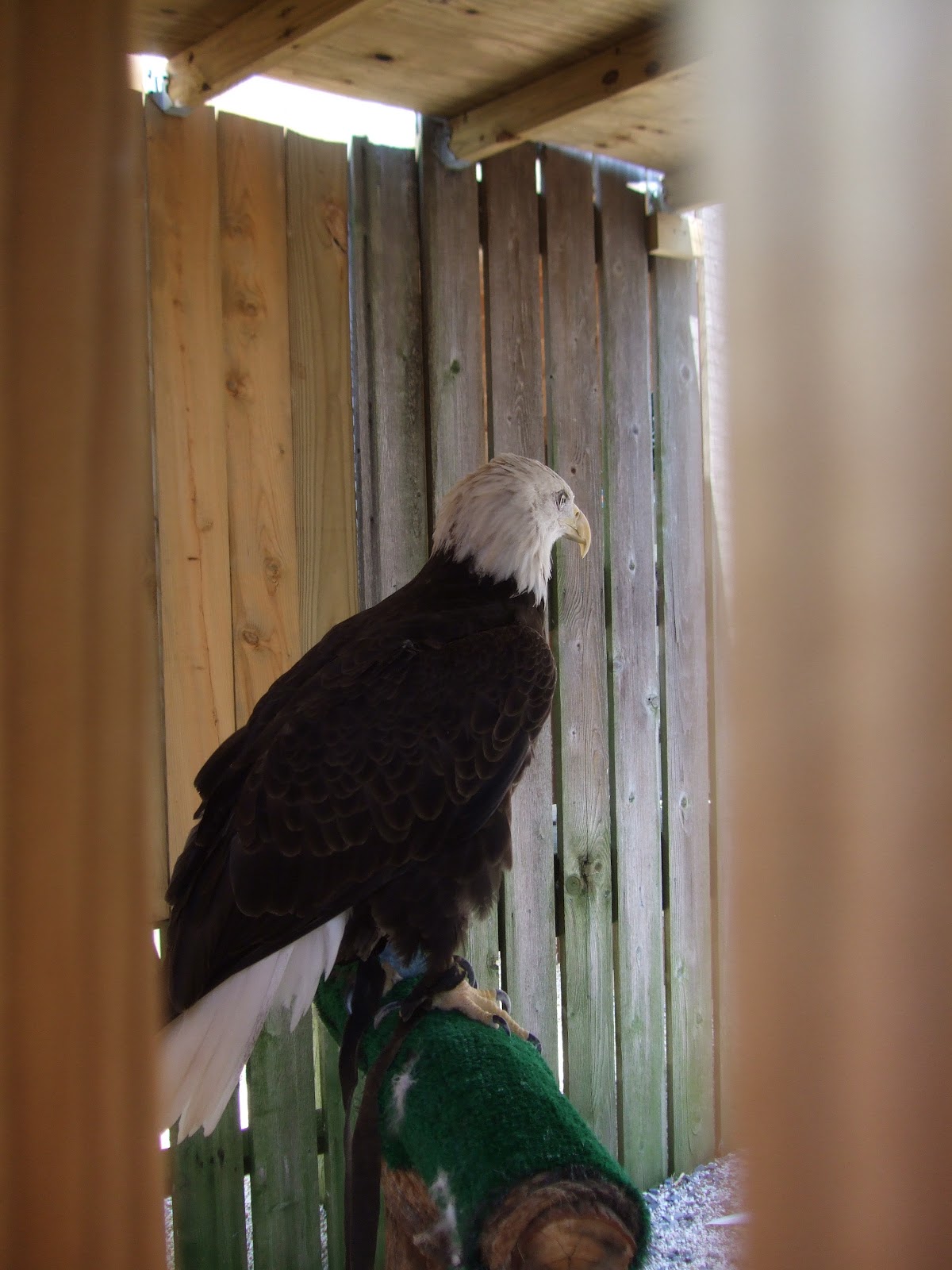
Wildlife Wednesdays: American Bald Eagle

Lest you think I torture my oldest son with all this hiking and outdoor stuff, there are parts he loves.  His favorite part of our Rocky Gap trip was the nature center with it's turtles and snakes and the aviary where we saw this guy.


"It's the American Bald Eagle!" he announced in a low, formal voice.  It was an excellent imitation of Sam the Eagle from The Muppets and those around us laughed.  Unperturbed, Gabe then serenaded the bird with our national anthem.

Friday, July 15, 2011

Photo Friday


I'm not certain (see earlier post regarding my qualifications), but I think this is the adult version of the Eastern Tiger Swallowtail caterpillar we saw this weekend.

Wednesday, July 13, 2011

Wildlife Wednesdays: Caterpillars

I am in no way qualified to write a post about bugs. Or for that matter any serious article on nature. In the interest of full disclosure: I nearly failed ninth grade biology.

But I'm curious about things (my step-dad would call it nosey). And I like to think I'm pretty good at research.

My cousin, Cassie, found this fellow in our campsite last weekend. I thought it was some kind of slug. Cassie, who I'd wager did not almost fail biology (she may have majored in it), knew it was a caterpillar.


He/she has cool "fake" eyes and we briefly held him/her in a paper cup so the boys could get a good look. Once we returned to the land of WiFi, it took all of twenty minutes to locate a similar image on the BugGuide.  I feel pretty confident labeling this guy a Tiger Swallowtail caterpillar.

It was a weekend for caterpillars.  The day after the Tiger Swallowtail sighting, Sherri spotted this fellow inching down the side of her tent.


That's my hand behind him for scale.  He's a pretty hefty caterpillar.  I spent more than an hour cruising various caterpillar image galleries and I still don't have a name for him.  Silvery Checkerspot?  Spiny Oakworm? I've no idea.  Let's just call him Carl.

- - - - - - - - - - - - - - -

Sources and Further Reading

Butterflies and Moths of North America
http://www.butterfliesandmoths.org/identify

BugGuide
http://bugguide.net/

Caterpillars of Eastern Forests, USGS
http://www.npwrc.usgs.gov/resource/insects/cateast/families.htm

Wednesday, July 6, 2011

Wildlife Wednesday: the Black Bear

The boys and I are going camping this weekend with my cousins.  Sherri booked our campsites and immediately called to tell me that the reservations came with a warning about bears.

This doesn't have me as freaked out as I will likely be laying in the darkness Saturday night, but it still seemed appropriate to make this Wildlife Wednesday about the North American Black Bear.

(Clipart photo.  I've never been this close.)

Black bears are the only bear native to Maryland. They were once found throughout the state, but now only live in the western mountains. Loss of habitat and indiscriminate hunting nearly eliminated black bears from in the state by the 1960s.  But black bears have proved adaptable and are making a comeback.  No longer on the endangered species list, Maryland now holds a lottery for black bear hunting licenses.  It's estimated that 600 black bears currently live in Maryland.

Black bears are omnivores and will eat just about anything, but mostly survive on berries, nuts, insects, small reptiles, fish and various vegetation. Adults typically weigh between 125 and 400 pounds.  That's the equivalent of eight Matthews!

Black bears are not as aggressive as their grizzly relatives, but they're still a large wild animal deserving respect. Never feed a bear. 

My favorite bit of bear research?  According to the Maryland DNR, no humans have ever been attacked by a black bear in Maryland.

Most interesting bear fact?  Bears don't actually growl, not even when threatened.

- - - - - - - - - - - -

Sources and Further Reading

"Be Bear Aware," Center for Wildlife Information (Matt highly recommends this particular link--silly video of a bear scratching his back)
http://www.centerforwildlifeinformation.org/BeBearAware/bebearaware.html

"Black Bear Encounters," Maryland Department of Natural Resources
http://www.dnr.state.md.us/huntersguide/blackbearencounters.asp

"Maryland Black Bear History and Management," Maryland Department of Natural Resources
http://dnr.maryland.gov/huntersguide/bearhunt_historymanagement.asp

"Maryland Black Bear Education Videos" (more about tracking and hunting), Maryland Department of Natural Resources
http://dnr.maryland.gov/huntersguide/BlackBearVideo.asp

North American Bear Center
http://www.bear.org/website/bear-pages/black-bear/basic-bear-facts.html

Wednesday, June 29, 2011

Wildlife Wednesday: Eastern Box Turtle

Welcome to the first installment of Wildlife Wednesday! Learning about wildlife is our favorite part of our adventures and it seems only appropriate to devote one day a week to what we've learned.

So for this first installment, meet the Eastern Box Turtle.


We met this fellow in the Scales and Tails Aviary at Soldier's Delight.  The ranger told us it was a male box turtle and explained she knew this by his coloring and shape of his shell.  I'd never seen one this orange before.

Eastern Box Turtles can grow as big as 8 inches.  They get their name from their unique ability to completely close their shells.  The box turtle has a hinged "plastron" or bottom shell.  It's a sort of door he can close behind his head, legs and tail.  Other turtles have the hinge, but most can't close completely.

The box turtle can be found in a variety of habitats and he'll eat just about anything, but moist forrests are his favorite abode.

The average lifespan of an Eastern Box Turtle is 25-30 years, but some have lived 40-50 years.  There are less credible reports of turtles living as long as 100 years!

Another thing we learned about Eastern Box Turtles is that it's not wise to take them from the wild.  The creatures are easily stressed and require more care than most people realize. Also, the females lay hundreds of eggs over a lifetime, but only 2-3 survive.  As with most things in nature, the less they're interfered with the better.

- - - - - - - - - - - - - -

Sources and Further Reading:

Box Turtles, Encyclopedia of Life
http://www.eol.org/pages/14127

Eastern Box Turtle, Fairfax County Public Schools
http://www.fcps.edu/islandcreekes/ecology/eastern_box_turtle.htm

The Eastern Box Turtle, Davidson College
http://www.bio.davidson.edu/people/midorcas/research/Contribute/box%20turtle/boxinfo.htm

Field Guide to Maryland's Turtles
http://dnr.maryland.gov/wildlife/plants_wildlife/herps/testudines/easternboxturtle.asp

Monday, June 27, 2011

Scientists in the Field

And back to our not-so-regularly-scheduled program. . .

Matt always has a mile long list of things he wants for his birthday.  Gabe is a little harder to buy for.  His interests tend to be a little more focused and he isn't in the habit of shouting, "I want that!" after every toy commerical.

Lately (and to my father's horror), Gabe has been interested in snakes.  He also loves to read. So, I thought maybe I'd get him some books about snakes.

Snake by Chris Mattison was the first one I picked out.


I knew Gabe would love it for the photographs and for all the little factoids on each snake.


The Trans-Pecos Rat Snake can grow as long as 6 feet, 6 inches!

And just in case the book didn't have enough cringe factor, it also has a full spread on Gabe's favorite snake: the Western Diamondback Rattlesnake.


I do not have my father's phobia of snakes, but there are still pages of this book that give me goosebumps.  Needless to say, Gabe loves it.

The other birthday book I purchased was the one that had me most excited.  I found The Snake Scientist by Sy Montgomery.  It's part of a series of books I just discovered, "Scientists in the Field." I suspect we will be getting a lot more of these (in fact, I've The Woods Scientist hidden for Matt's birthday.  Shhh!)


This book follows Bob Mason and his study of red-sided garter snakes. It's detailed and yet written on a child's level. I've started to read it to Gabe a couple of times, but he takes it from me and goes where it's quiet so he can study on his own.


I was rather pleased with my finds for the young paleontologist/mathematician/biologist.

My dad was appalled.

"What if he sees a real snake, picks it up and brings it inside?" he asked.

I answered that I wasn't worried about it.  Knowledge is power.  I want to encourage his interests. If Gabe wants to be the household snake expert, then it's the perfect opportunity to talk about snakes and respecting them. 

When we got home, however, I took the precaution of warning both boys.  There are to be no snakes in Mommy's house.  EVER.

- - - - - - - - - - - - - - - - - - -  

Snake by Chris Mattison at Barnes and Noble

Scientists in the Field series at Barnes and Noble

Wednesday, June 15, 2011

Bugs Pollyanna Style

I was one of those kids who ran screaming from whatever was buzzing around my head.  I passionately hated bugs with few exceptions. Spiders were (and are to some degree) my nemesis. 

I admit my fears of the insect world are a bit irrational.  But only a bit.  After all, I'm deathly allergic to bees and carry an Epipen where ever I go.  I grew up in an old house where wolf spiders commonly grow to the size of small mice.  I was once bit by a Brown Recluse and have photos of the necrotic wound to prove it.

But even with this reinforcement, I do not want to pass my fear on to my boys.  I want them to respect and revere nature, not scream and throw heavy objects at it.  Reverance to bugs has been a hard behavior to model, especially in regard to spiders. 

As you know (because I keep bringing it up), we saw a black widow last Saturday.  In the first few moments of that experience, my heart pounded and my hands shook (before you think I'm a total sissy, let me tell you, I'd actually brushed my leg against her web). I fought to keep my voice calm as I squatted down a few feet from her.

"Look how her web is close to the ground.  Why do you think that is?" I asked.  The boys squatted carefully beside me and the three of us spent several minutes watching the spider wrap up her lunch.  Sitting there, thinking as an observer, suppressing the "OH MY GOD, RUN!" instinct, I had to admit, the black widow was beautiful in her creepy way.  Her black body glistened and her red hourglass glowed like neon. I marveled how as my curiosity about her grew, my fear diminished. I felt like the Pollyanna of bugs, finding the good in a black widow.

Not that my fears are gone, mind you.  As I write this and think of that spider, I've goosebumps on my arms and the hair on the back of my neck is standing up.  And I can't promise you, if I ever see something like this again, I won't scream and run.

- - - - - - - - - - -

In an earlier post, I mentioned how on our hikes we write nature questions on an index card to look up later.  Someone asked about our resources and here is my answer in regard to bugs.

Favorite sites for bug research:

Bug Guide
http://bugguide.net/

Animal Diversity Web
http://animaldiversity.ummz.umich.edu/
(much, much more than bugs)

What's that Bug?
http://www.whatsthatbug.com/

Saturday, June 11, 2011

Park Quest 3: If At First You Don't Succeed. . .

We checked the weather obsessively this morning.  The forecast was for thunderstorms, but we were hoping to get both a quest and the pool in.  The coast was clear at 10 a.m. when we left the house armed with a picnic lunch and our daypack.

We headed down 301 for about 50 miles to Brandywine, Maryland.  Today's quest involved letterboxing at Cedarville State Forest.  The park quest website explains letterboxing well:

"Letterboxes are small, weatherproof boxes that usually contain a log book, a rubber stamp and an ink pad. They are hidden in publicly accessible places and the clues made available participants. The finders make an imprint of the letterbox's stamp on their stamp sheet or personal log book, and leave an imprint of their personal stamp on the letterbox's logbook."

So, it's kind of like geocaching, except instead of following gps coordinates, you follow a set of clues.  To complete the Cedarville quest we had only to find two out of four letter boxes.  Piece of cake, right?

We set off for the first box in good spirits. It was hot (about 90 degrees), but we had plenty of water and the forest was lush and beautiful.


We seemed to be following all the clues with ease and it only took 30 minutes to get to where we expected the first box to be.

Did you note that language?  Where we expected?

We couldn't find that darn box.  We saw this little fellow.


And these cool mushrooms.


And even a big pile of horse poo.


But no letterbox.  In searching, I very nearly put my bare ankle up against this fellow!


(My apologies for the blurry photo.  I hate spiders. . . Let me rephrase that, I HATE spiders and my hand was shaking when I took the picture.)

The black widow about did it.  After an hour of searching, we officially determined Letterbox 1 missing in action.  We trudged back to the car: hot, tired and in poor spirits.

At the car, we revived ourselves with some Gator Aide and grapes.  We turned down another path to find Letterbox #2.  We found it in 25 minutes!  Buoyed by our success, we decided to try Letterbox #3.  Another quick success!  We returned to park headquarters and got our passport stamped. 

Park Quest #3 Complete.

We drove home, dropped our gear on the floor and quickly changed into our swim suits.  We had time to jump in the pool and dunk our heads a few times before the rain started.  Followed shortly by thunder.  The boys were bummed by the short pool time, but they rallied with a promise of ice cream after dinner.

Lesson of the day:  success doesn't always come in the manner you expect.

- - - - - - -

Quest Summary

Favorite Thing:

Both boys:  Seeing the Black Widow Spider.

Least Favorite Thing:

Gabe:  Walking very hard.

Matt:  Not finding the first box and the buzzy bugs.


Thursday, July 15, 2010

Things that Slither

Ophidiophobia, or the abnormal fear of snakes, runs in my family.

My grandmother trampled me escaping a snake someone thought they saw near our picnic.  My father jumped out the second story window of the stable because he saw a snake skin.  My cousin, Sherri, couldn't watch the Crocodile Hunter because of the frequent appearance of snakes on that program.

It's a good thing none of these people have been on our Park Quests.

At Merkle, the Visitor's Center included this Discovery Room whose occupants included a Red Corn Snake, a ghostly Albino King Snake and a just-shy-of-the record, seven foot Gray Rat Snake.


At Calvert Cliffs, we watched this enormous black snake pass under the walkway.


At Cunningham Falls, a ranger waited in the parking lot with this Rat Snake (the family phobia has obviously skipped my boys).

Also at Cunningham Falls was a warning regarding Timber Rattlesnakes sighted on the more mountainous trails.

Happily, there were no such snake encounters on the South Mountain quest.

There was, however, a snake at the Bowie Baysox game!


Ambassadors from Busch Gardens plugging their park.